
AI Voice Assistants vs. Traditional Call Handling

AI voice assistants are reshaping how businesses manage calls by offering faster response times, consistent performance, and lower costs compared to human-operated methods. They handle multiple calls simultaneously, operate 24/7, and integrate with CRM systems to streamline workflows. In contrast, human agents are limited by schedules, staffing, and variability in performance, often leading to longer wait times and higher expenses.
Key Takeaways:
- Efficiency: AI manages up to 1,000 calls per hour, versus ~200 for human teams, with response times under 5 seconds.
- Availability: Always on (24/7/365), unlike human agents who require breaks and time off.
- Cost: AI reduces operational costs by 30%-65%, with pricing models starting as low as $50/month or $0.02 per call.
- Customer Experience: AI ensures instant responses, personalization through CRM integration, and consistent service quality.
Quick Comparison:
| Aspect | AI Voice Assistants | Human Agents |
|---|---|---|
| Call Capacity | Unlimited, simultaneous calls | One call per agent |
| Response Time | Under 5 seconds | Several minutes during peak |
| Availability | 24/7/365 | Limited by shifts and holidays |
| Cost | $50–$500/month or $0.02/call | $70,000+/year per agent |
| Error Reduction | High (automated processes) | Prone to fatigue-related errors |
| Emotional Handling | Limited, escalation for complex | Genuine empathy for sensitive cases |
AI platforms like Voxtell AI showcase these advantages by automating tasks such as call answering, lead qualification, and follow-ups, ensuring businesses never miss opportunities while optimizing costs and performance.
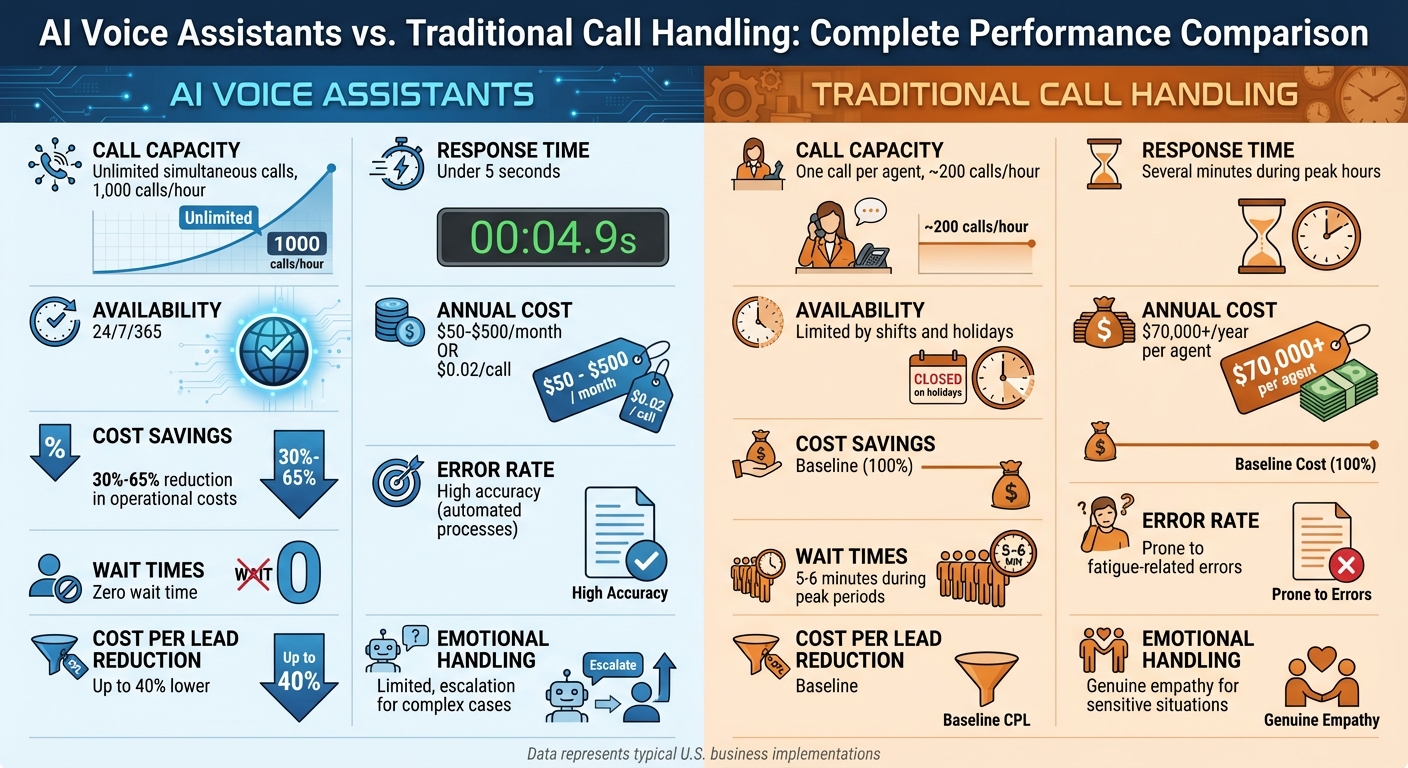
AI Voice Assistants vs Traditional Call Handling: Key Metrics Comparison
Availability and Scalability Comparison
Call Capacity and Peak Performance
Traditional call handling has a clear limitation: human agents can only manage one call at a time. This creates bottlenecks, especially during promotional campaigns, seasonal spikes, or emergencies. When call volumes surge, wait times often stretch to 5–6 minutes, leading many frustrated callers to hang up before being helped.
AI voice assistants, however, operate on a completely different level. These cloud-based systems can handle hundreds or even thousands of calls simultaneously, adjusting in real-time to meet demand. For instance, AI voice dialers are capable of managing up to 1,000 calls per hour, compared to the approximate 200 calls per hour handled by traditional setups. Even during peak periods, AI systems maintain response times under 5 seconds, whereas traditional teams struggle as queues grow longer and service levels drop. This ability to scale on demand has a direct impact on maintaining reliability, especially when paired with continuous availability.
24/7 Availability Impact on Business
Beyond peak performance, the round-the-clock availability of AI systems sets them apart from traditional methods. Human-staffed call centers often face coverage gaps during nights, weekends, and holidays. In contrast, AI voice assistants are always on - operating 24/7/365 without interruptions. Whether it’s late at night or during a federal holiday, these systems provide the same speed and consistency, ensuring customers across all U.S. time zones are met with a responsive solution instead of an answering machine.
This constant availability is a game-changer for industries like HVAC, plumbing, medical answering services, and legal intake, where after-hours calls often involve urgent situations or high-value leads. AI platforms, such as Voxtell AI, excel in this area by managing tasks like call answering, lead qualification, appointment scheduling, and automated follow-ups seamlessly.
When human agents aren’t available, traditional systems lose potential inquiries. AI systems, on the other hand, ensure every call is answered, every interaction is logged, and unresolved issues are either addressed immediately or scheduled for a callback during business hours. Over time, this leads to more conversions, stronger customer loyalty, and a reputation for being consistently dependable.
Efficiency and Performance Comparison
Consistency and Multitasking
Human agents often experience dips in performance due to fatigue or stress, especially during high-demand periods. For instance, an agent might sound cheerful and energetic at 9:00 AM but come across as drained by 4:00 PM. Similarly, someone who confidently handles objections early in the day might struggle later as the workload takes its toll. This natural variability can lead to inconsistent customer experiences.
AI voice assistants, on the other hand, maintain a steady level of performance no matter the time of day or the number of calls they handle. Whether it’s the first call of the day or the ten-thousandth, the AI delivers the same greeting, tone, and process every time. Routine queries - like business hours, pricing, or appointment availability - are addressed with lightning speed, typically within 5 seconds. This is because the AI pulls information directly from integrated systems, bypassing the delays associated with manual data retrieval.
When it comes to multitasking, AI systems shine even brighter. While a human agent can only manage one call at a time, AI can handle hundreds or even thousands simultaneously. This scalability means no customer is left waiting, even during peak call volumes.
Modern AI platforms also come equipped with multilingual capabilities, allowing them to switch seamlessly between languages like English and Spanish without compromising speed or accuracy. Traditional call centers, by contrast, need to hire and train separate teams for different languages, which can lead to gaps in service - especially during off-hours.
This level of consistency not only ensures smoother call handling but also minimizes errors and downtime, creating a more reliable customer service experience.
Error Reduction and Downtime
AI systems go beyond consistency - they actively reduce errors and downtime, two common pitfalls in human-led operations. Human agents are prone to mistakes, especially during long shifts. They might mishear a name, transpose numbers when entering data, or skip crucial verification steps when rushed or fatigued. Additionally, manual note-taking often results in incomplete or inaccurate records, which can affect follow-up actions and customer satisfaction.
AI voice assistants eliminate most of these issues by following strict, pre-set logic and trained models. They automatically log call details, generate transcripts, and accurately capture customer data, reducing the chances of errors that come with manual processes. When mistakes do occur - usually in situations the system hasn’t encountered before - they can be corrected centrally, ensuring the fix is applied across all future interactions.
Downtime is another area where AI outperforms human teams. Human agents need breaks, meals, and time off, which can lead to idle time between calls or delays in responding to customers. AI systems, however, transition from one call to the next instantly, cutting idle time by up to 25–30% in some cases.
Platforms like Voxtell AI operate around the clock, unaffected by holidays, shift changes, or personal needs. Scheduled updates and maintenance are performed during low-traffic hours, ensuring near-constant availability. This means every call is answered, every lead is followed up on, and every appointment is scheduled - no matter the time of day or the volume of calls. The result? Higher efficiency, fewer errors, and more predictable performance compared to human teams.
Cost Analysis: AI vs. Traditional Call Handling
Traditional Call Center Operating Costs
Running a traditional call center in the U.S. comes with hefty expenses. Labor costs typically make up 60–70% of the total budget, with agents earning between $35,000 and $45,000 annually. Once you factor in benefits, payroll taxes, and training expenses (ranging from $5,000 to $10,000 per agent), the yearly cost per agent easily surpasses $70,000. On top of that, facility-related costs - like rent, utilities, telecom infrastructure, and equipment - add another $10,000–$20,000 per agent annually. For a small team, these numbers can quickly climb past $700,000 a year.
Employee turnover only adds to the financial strain. With turnover rates hovering between 30% and 45%, replacing an agent can cost an additional $10,000 to $20,000 in recruiting and onboarding. For a center with 50 agents, these turnover expenses can range from $500,000 to $1 million annually. All these factors combine to drive up the cost per call - around $3–$6 for inbound support and $5–$10 for outbound sales.
Now, let’s look at how AI voice assistants completely transform this cost equation.
AI Voice Assistant Pricing Models
AI voice assistants operate on a completely different cost model, one that’s flexible and usage-driven. Instead of being tied to fixed costs like salaries, benefits, and infrastructure, AI platforms such as Voxtell AI use pricing structures that scale with actual call volume. Most solutions offer either a monthly subscription - typically between $50 and $500 per user - or a pay-per-use model, charging around $0.02–$0.10 per call or $0.05–$0.20 per minute.
This shift can lead to massive savings. Research shows that integrating AI can reduce operational costs by 30%–65%, and in some cases, savings can reach as high as 70%–90%. AI systems also significantly lower costs per lead - by as much as 40% - due to their ability to handle up to 1,000 calls per hour, compared to just 200 for traditional setups. Platforms like Voxtell AI streamline processes such as call answering, lead qualification, appointment scheduling, and follow-ups. By integrating seamlessly with your CRM, these systems reduce interaction costs to approximately $0.50–$2, making operations not only more efficient but also more cost-effective.
sbb-itb-ae0e619
Customer Experience Comparison
AI voice assistants are redefining customer service by responding in under five seconds. This eliminates queues, busy signals, voicemails, and callback messages. On the other hand, traditional call centers often leave customers waiting for several minutes, especially during peak times or after hours. This delay can result in missed calls and lost opportunities. Research highlights that adopting AI-powered systems has effectively reduced wait times to zero.
Because AI assistants operate 24/7, customers are guaranteed immediate attention at any time. This constant availability forms the backbone of a seamless and responsive customer experience.
AI-Powered Personalization
Quick responses are just the beginning. AI voice assistants take it a step further with personalized interactions. Using natural language processing and machine learning, these systems can understand customer needs in real time. They pick up on details like names, order numbers, and product preferences to tailor responses based on the conversation's context. When integrated with CRM systems, AI assistants access customer history - such as previous purchases or support tickets - to deliver highly customized service. They can even route high-value customers to priority support automatically.
For instance, platforms like Voxtell AI demonstrate how integrating historical customer data improves personalization. This approach not only enhances customer satisfaction but also boosts contact rates.
"The best decision we've made so far was allowing Voxtell AI to integrate with our company, offering dynamic, intelligent, and modern service. Thanks to this partnership, Amanda Construction has become a benchmark for personalized and dynamic service in rural New England." [Amanda Construction, 2023]
AI vs. Human Interaction: Strengths and Weaknesses
AI assistants shine when it comes to routine tasks like checking order statuses or scheduling appointments. By using a centralized knowledge base and strictly following approved scripts and compliance guidelines, they deliver consistent and error-free results. Unlike human agents, they don’t suffer from fatigue or variability in performance.
However, human operators excel in handling more nuanced situations, such as resolving billing disputes or addressing sensitive complaints. Humans can detect subtle emotional cues and respond with genuine empathy - something AI systems, despite their ability to recognize frustration and escalate calls, cannot fully replicate.
Many businesses in the U.S. have adopted a hybrid approach to maximize the strengths of both AI and human agents. AI systems manage initial triage and routine inquiries, while more complex or emotionally charged cases are escalated to human agents. Platforms like Voxtell AI make this seamless by automating tasks like call answering, lead qualification, and follow-ups. This ensures customers don’t need to repeat themselves and always receive the right level of support.
The following comparison highlights the key differences between AI and human interaction:
| Aspect | AI Voice Assistants | Human Operators |
|---|---|---|
| Wait Times | Under 5 seconds | Several minutes during peak hours |
| Personalization | Real-time, data-driven via NLP | High with skilled agents, but variable |
| Consistency | Uniform across all interactions | Varies with individual performance |
| Emotional Handling | Limited, rule-based empathy | Genuine empathy |
| Scalability | Handles unlimited simultaneous calls | Limited by staff availability |
Voxtell AI Features vs. Traditional Methods
When compared to manual call centers, Voxtell AI showcases how automation can transform real-time call handling. Traditional call centers often rely on manual processes that slow down lead conversion. Agents spend a lot of time logging notes, tracking follow-ups, and entering data into CRM systems - tasks that become even more challenging during peak hours. Voxtell AI simplifies this by automating the entire workflow, from the first contact to final conversion, making the process much more efficient.
Automated Lead Qualification and Follow-Ups
Voxtell AI takes workflow automation to the next level by improving lead management with real-time qualification. Using natural language processing, the platform evaluates caller intent, tone, and responses instantly. It scores leads based on urgency and interest, qualifying prospects on the spot - no human input required. In contrast, traditional methods rely on agents manually noting details and scheduling follow-ups, which can lead to errors and delays. AI voice systems, like Voxtell AI, can boost contact rates by up to 25% compared to traditional methods.
The platform also schedules and initiates follow-up calls or messages automatically, integrating with calendars to ensure optimal timing and 24/7 availability. Manual scheduling in traditional setups often results in missed opportunities, with abandonment rates reaching approximately 30% during after-hours or high call volumes. On top of that, Voxtell AI can cut the cost per lead by up to 40%.
CRM Integration and Call Transcripts
Voxtell AI integrates seamlessly with popular CRM systems like Salesforce and HubSpot, syncing call data, lead scores, and outcomes in real time via APIs. This eliminates the errors commonly associated with manual data entry and provides a complete view of customer interactions. Features like intelligent routing, based on customer history, further enhance efficiency. Research shows that these AI-driven integrations improve productivity and ensure consistent data logging.
The system also generates detailed transcripts of every conversation, enriched with sentiment analysis and action items, which are stored directly within the CRM for easy access. Unlike traditional methods that rely on potentially inconsistent notes from agents, Voxtell AI ensures uniform records, supports multiple languages, and scales effortlessly without losing quality.
"The best decision we've made so far was allowing Voxtell AI to integrate with our company, offering dynamic, intelligent, and modern service." - Amanda Construction
Conclusion
AI voice assistants have undeniably surpassed traditional call handling methods in terms of availability, efficiency, and cost savings. Traditional systems often struggle with limited hours, high labor expenses, and inconsistent performance during busy periods. These manual processes can result in long hold times, missed calls, and service quality that fluctuates based on agent training and fatigue.
In contrast, AI voice assistants ensure round-the-clock availability, meaning businesses never miss a call - even during nights, weekends, or holidays. They can handle unlimited simultaneous conversations, eliminating queues and maintaining consistent performance no matter how high the call volume gets.
Voxtell AI exemplifies these benefits by offering automated lead qualification, real-time CRM integration, and intelligent follow-ups. It removes common bottlenecks like manual data entry and scheduling, which often slow down traditional call centers. By automating tasks such as call transcriptions, lead scoring, and data syncing, it creates a seamless workflow that traditional methods simply can’t match.
For U.S. businesses dealing with high call volumes, multiple time zones, or seasonal demand surges, AI voice assistants like Voxtell AI provide faster response times, reliable service quality, and significant cost reductions. They transform every call into an opportunity, setting a new standard for customer engagement and redefining how businesses connect with their customers.
FAQs
How do AI voice assistants enhance customer service compared to traditional call handling?
AI voice assistants are transforming customer service with their round-the-clock availability, ensuring every call is attended to and follow-ups are handled without delay. They can handle large volumes of calls efficiently, giving customers a seamless and hassle-free experience.
These tools are also capable of qualifying leads, scheduling appointments, and generating precise call transcripts, all while delivering consistent service. By taking over repetitive tasks, they allow human agents to concentrate on more complex issues, ultimately enhancing customer satisfaction.
How do AI voice assistants help reduce costs compared to traditional call centers?
AI voice assistants, like those provided by Voxtell AI, can cut costs by taking over tasks such as handling calls, qualifying leads, and scheduling appointments. This reduces the need to hire extra staff and helps avoid missed opportunities, ultimately saving money on day-to-day operations.
Since they work around the clock without needing human oversight, these assistants allow businesses to manage customer interactions efficiently while keeping expenses in check.
Are AI voice assistants as effective as human agents in managing complex customer interactions?
AI voice assistants, such as those provided by Voxtell AI, are perfect for tackling everyday tasks like answering calls, qualifying leads, and scheduling appointments. These tools operate round the clock, delivering consistent performance and lightning-fast responses.
That said, there are still areas where human agents shine - especially when it comes to handling more complex situations that demand empathy or advanced problem-solving. By blending the reliability of AI with the adaptability of human support, businesses can offer a smooth and efficient customer experience.