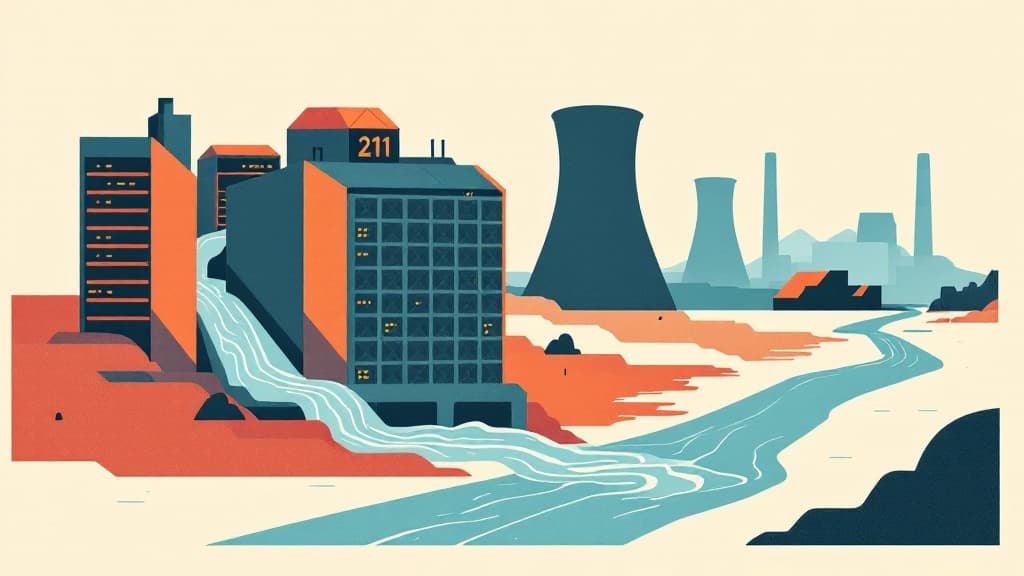
Nvidia has unveiled a new liquid cooling architecture designed to reduce water consumption inside data centers. The system is a meaningful engineering step, but analysts and environmental advocates are quick to point out that it addresses only a fraction of AI's total water footprint.
The Details
Nvidia's new cooling approach moves heat management closer to the hardware itself, reducing reliance on traditional water-cooled systems that consume significant volumes inside the facility. On paper, that sounds like progress.
The problem is where AI's water use actually comes from:
- Inside the data center: cooling chips and servers directly, where Nvidia's solution applies
- Outside the data center: at fossil fuel power plants that generate the electricity those servers consume
The second category is far larger. Thermal power plants, which still supply the majority of grid electricity in the United States, require enormous amounts of water to generate steam and cool equipment. Every kilowatt-hour an AI workload consumes has a water cost upstream that no data center cooling innovation touches.
In other words, Nvidia's announcement solves the smaller part of a much larger equation.
Why This Matters for Service Providers
MSPs and telecom resellers are increasingly positioning AI services as a core offering. As that happens, enterprise clients, especially those with ESG reporting requirements or sustainability commitments, will start asking harder questions about the environmental cost of the AI tools they're paying for.
Service providers who get ahead of this conversation will have a clear differentiator. Understanding where AI infrastructure actually sits on the environmental impact spectrum, and being able to explain it accurately, builds credibility with clients who are tired of greenwashing.
There is also a procurement angle here. As hyperscalers and AI platform vendors make competing sustainability claims, the ability to evaluate those claims critically becomes a business skill, not just a PR exercise. Clients will increasingly rely on their MSPs and technology advisors to cut through the noise.
Finally, the energy and water demands of AI workloads are already influencing data center geography and pricing. Regions with cleaner grids and cooler climates are becoming more attractive for AI infrastructure, which can affect latency, compliance, and ultimately the cost of the AI services you resell.
Looking Ahead
Watch for enterprise clients to begin including AI infrastructure sustainability in vendor due diligence questionnaires over the next 12 to 18 months. Service providers who can speak to this clearly will be better positioned than those who simply repeat vendor marketing.
For the full story, read the original article on TechCrunch AI.