Tesla has dramatically increased its 2026 capital expenditure plan to $25 billion, nearly triple what the company has historically spent in a given year. The move signals a major strategic push into AI infrastructure and physical expansion, even at the cost of near-term financial performance.
The Details
Tesla's CFO confirmed that the company expects negative free cash flow for the remainder of 2026 as a direct result of this spending surge. The $25 billion commitment represents a significant departure from Tesla's historical capex patterns, which have typically ranged in the low-to-mid single-digit billions annually.
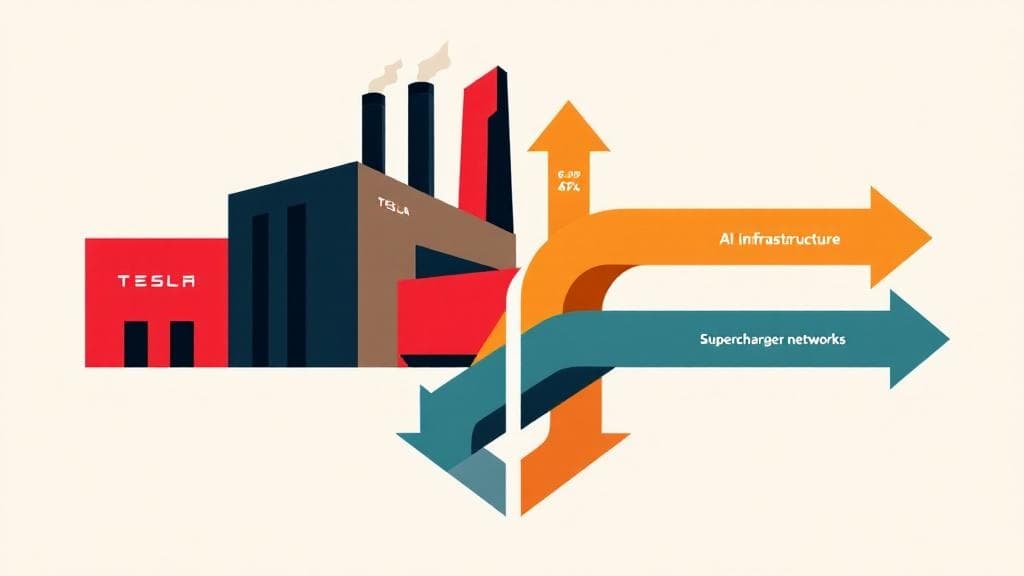
The spending is directed toward several key areas:
- AI data center infrastructure to support autonomous driving and robotics development
- Manufacturing expansion, including scaling production capacity for new vehicle lines
- Energy storage and generation facilities tied to Tesla's growing energy business
- Supercharger network and supporting infrastructure
"We're making significant investments that we believe will pay off," Tesla's CFO noted, acknowledging the short-term cash flow impact.
The scale of this commitment puts Tesla in the same league as hyperscalers and major cloud providers when it comes to AI infrastructure spending, a notable shift for a company still primarily known as an automaker.
Why This Matters for Service Providers
At first glance, Tesla's capex decisions seem removed from the MSP and telecom reseller world. But the broader signal here is hard to ignore: companies across every sector are now committing capital at scale to AI infrastructure, and that wave creates downstream opportunities and pressures for service providers.
When enterprises accelerate AI investment, demand rises for the managed services, connectivity, and communication tools that sit on top of that infrastructure. MSPs who have already positioned themselves around AI-enabled services are better placed to capture that demand.
The key takeaway for service providers is that AI is no longer a feature or an add-on; it is becoming a core infrastructure investment category. Clients who once asked "should we explore AI?" are now asking "how do we deploy it faster?" MSPs that haven't yet built out an AI service offering risk being left behind as that conversation accelerates.
If you're still working out how to add AI capabilities to your stack, the white-label AI voice agent model is one of the lower-barrier entry points worth examining.
Looking Ahead
Watch whether Tesla's aggressive AI spending prompts similar moves from other large enterprises outside the traditional tech sector, which could accelerate client-side AI adoption timelines faster than most MSPs are currently planning for.
For the full story, read the original article on TechCrunch AI.